Evidence log
This page publishes primary documents that articles on this site rely on, where they can be published safely. It exists so that a reader does not have to take the site's word for anything that a document can establish directly.
Not everything can go here. Much of the correspondence this site works from contains personal information about residents and staff, and some of it is subject to obligations that prevent publication. Where a document cannot be published, the relevant article names it, dates it and says what it shows. Peabody holds copies of all correspondence referred to on this site.
How documents are prepared
Every document published here is redacted before publication in accordance with the site's practice of not identifying the building or naming individual staff. Redaction is applied by converting the document to an image and removing the text permanently, rather than by covering it in a PDF, where the underlying text usually remains readable. Each entry below states exactly what was removed and why.
Nothing else is altered. No text is added, moved or rewritten.
Peabody Trust: independent review of a section 21 and 22 request, 4 November 2025
This is the review referred to in What does Peabody have to hide? and Peabody Broke the Law. A Resident Had to Prosecute It. It is a letter to the leaseholder reporting the outcome of a review of the leaseholder's section 21 and section 22 requests for the 2023/24 service charge year. The letter says the review was requested by a named Peabody officer, whose name is redacted, and it is signed "Independent Consultant".
Letter
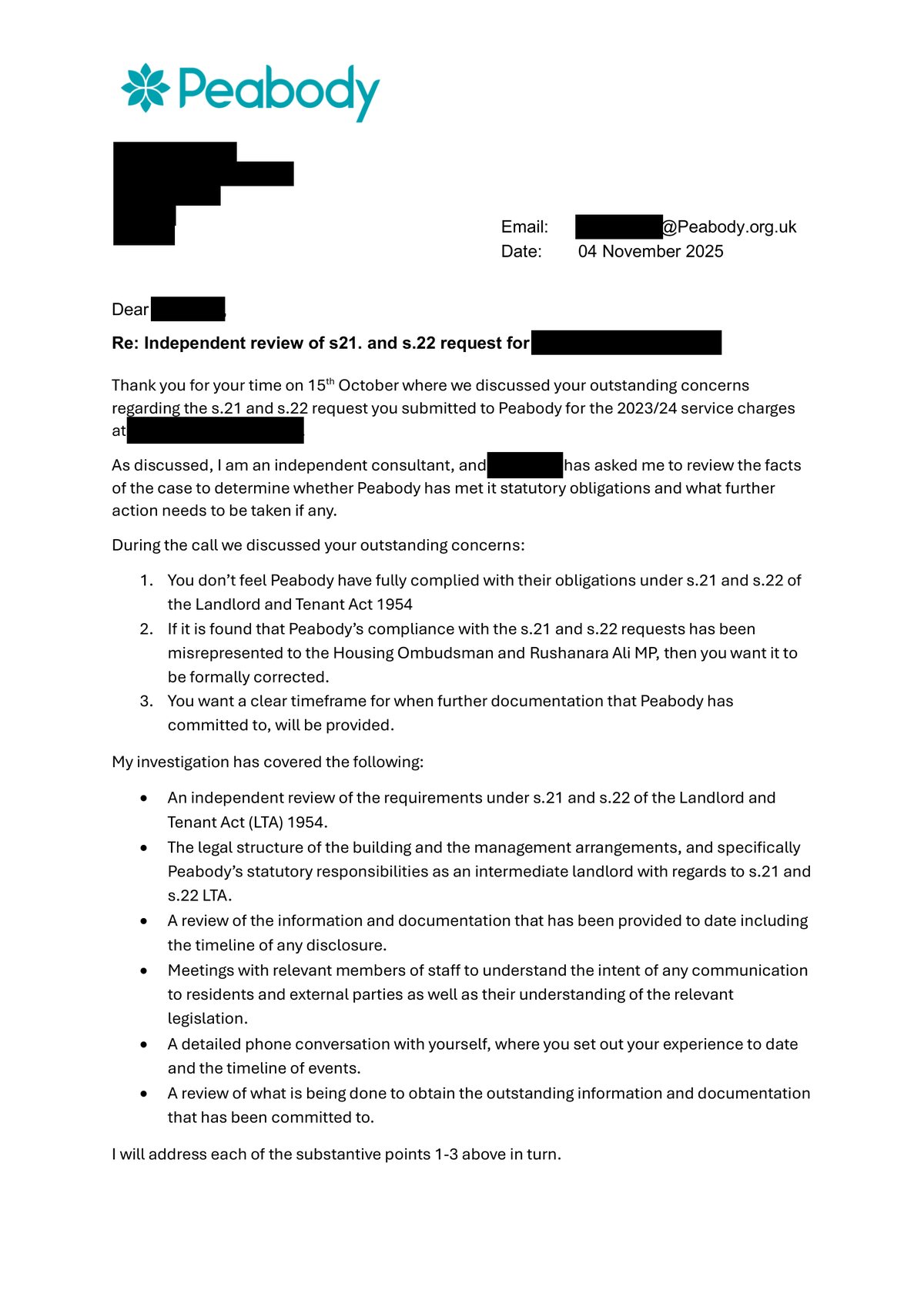
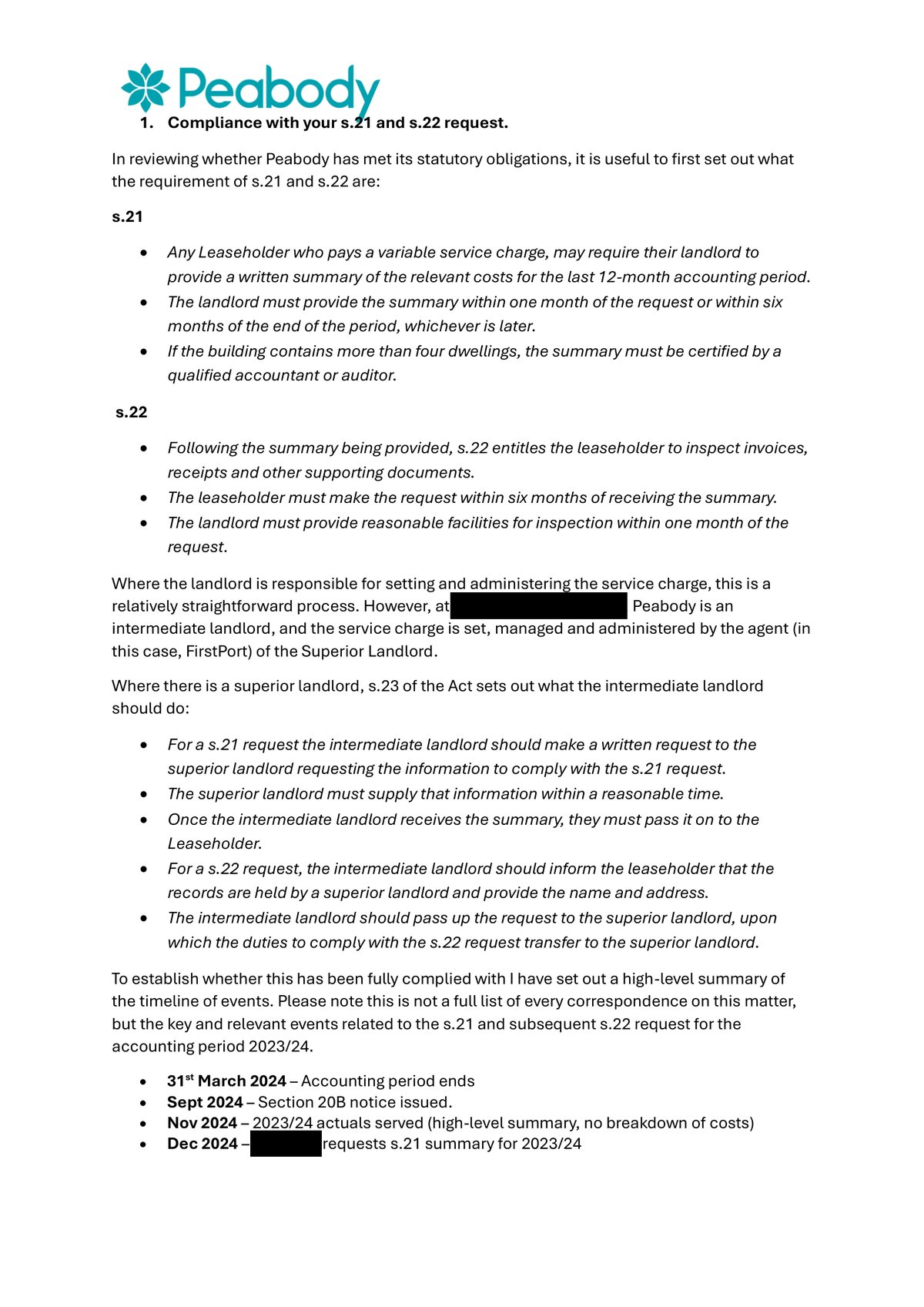
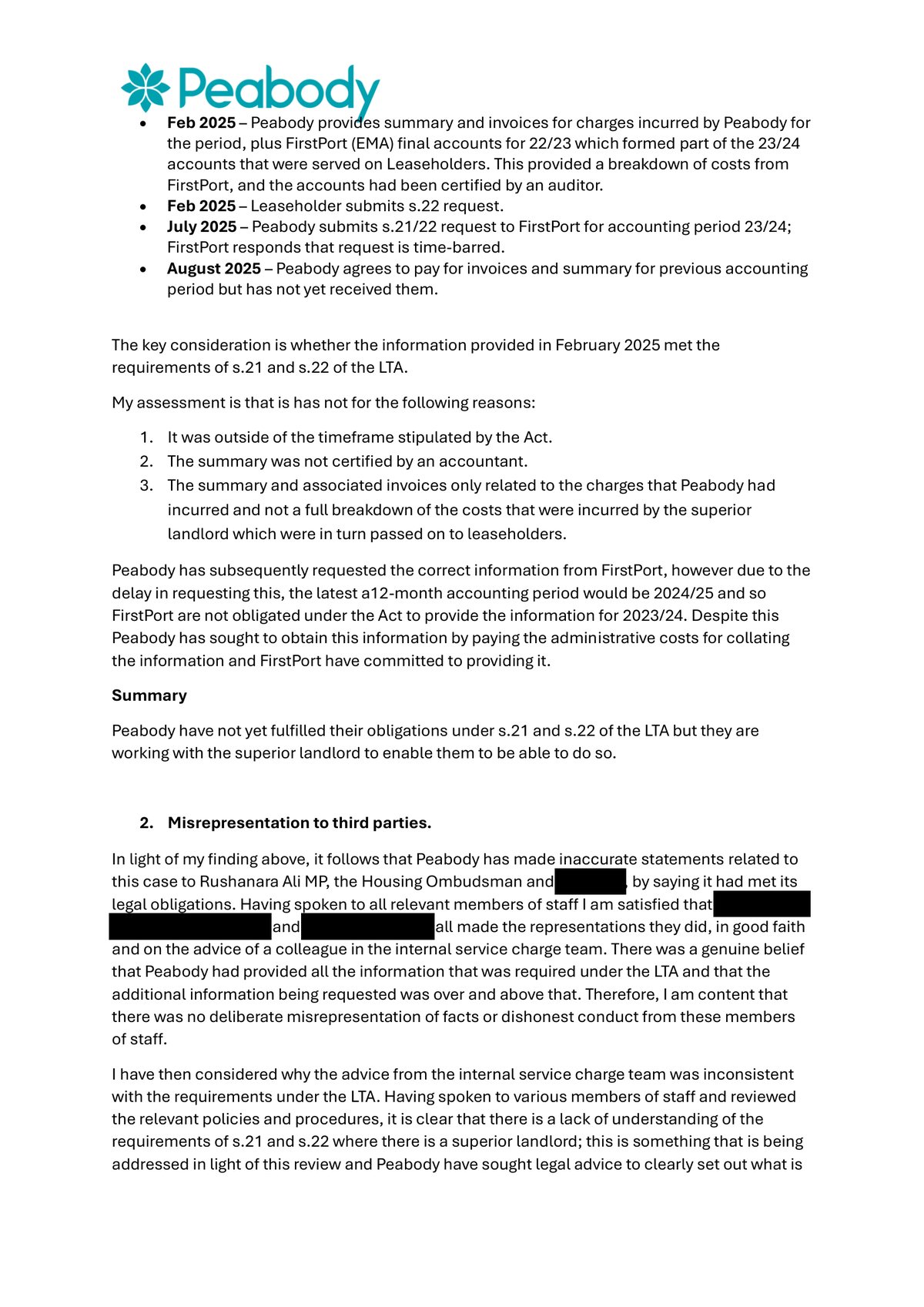
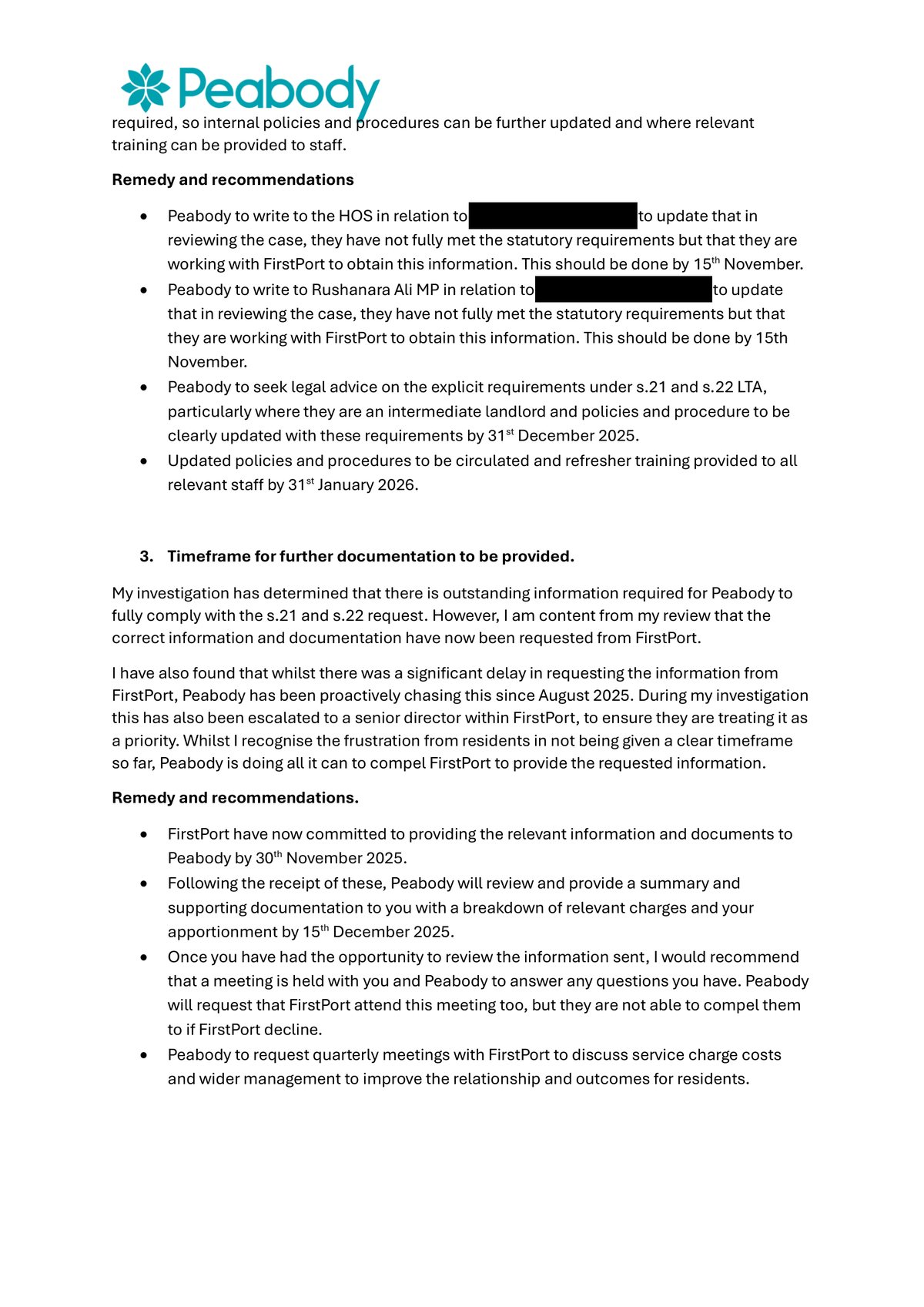
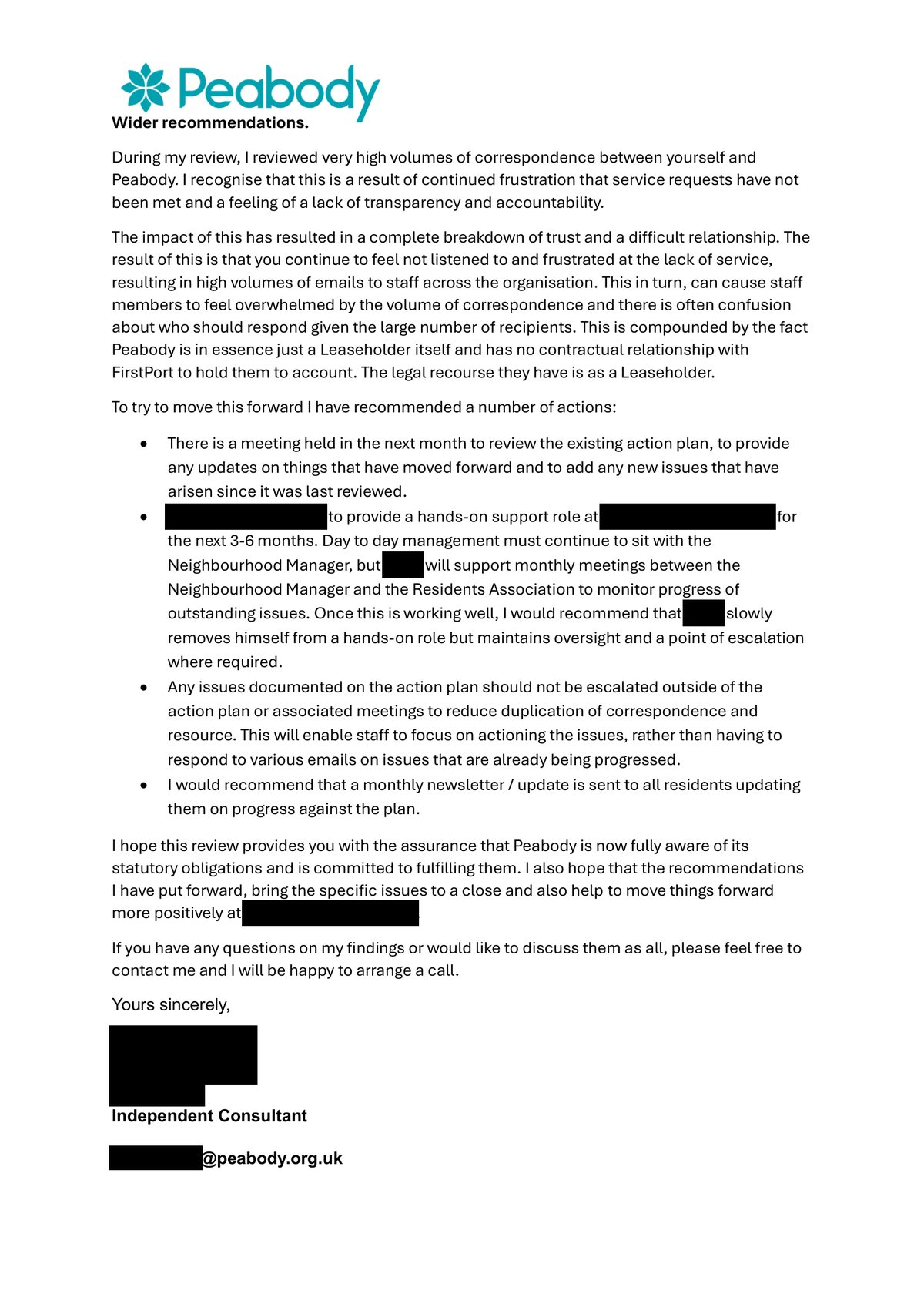
What it establishes. That the reviewer concluded Peabody had "not yet fulfilled their obligations under s.21 and s.22" for the 2023/24 year. Of the information Peabody provided in February 2025, the letter says it "was outside of the timeframe stipulated by the Act", that "the summary was not certified by an accountant", and that it covered only the charges Peabody itself had incurred, not the costs incurred by the superior landlord that were passed on to leaseholders. It finds that "Peabody has made inaccurate statements related to this case to Rushanara Ali MP, the Housing Ombudsman and [the leaseholder], by saying it had met its legal obligations".
It records the reviewer's view that the staff concerned acted "in good faith and on the advice of a colleague in the internal service charge team", that there was "no deliberate misrepresentation of facts or dishonest conduct from these members of staff", and that "there is a lack of understanding of the requirements of s.21 and s.22 where there is a superior landlord". It sets deadlines: Peabody to write to the Housing Ombudsman and to the MP by 15 November 2025; policies and procedures updated by 31 December 2025; refresher training for relevant staff by 31 January 2026; the managing agent to provide the outstanding information by 30 November 2025; and Peabody to provide a summary and supporting documentation by 15 December 2025.
A note on the text. Page 1 of the letter refers to the "Landlord and Tenant Act 1954". Sections 21 and 22, which the letter goes on to discuss, are in the Landlord and Tenant Act 1985.
Redactions. The building name is removed wherever it appears, as are the street, city and postcode in the address block, because together they identify the building. The names of the Peabody officers and staff mentioned in the letter are removed, including the writer's name in the typed sign-off, the handwritten signature and the first part of the email address, in line with this site's practice of identifying staff by role rather than name. The domain of the email address is left visible. The Housing Ombudsman's case reference is removed. The leaseholder's name is also removed wherever it appears, as an exception to this site's usual practice. Square brackets in the quotations above mark where a redacted name has been replaced by a description. Nothing else is removed.
Peabody Trust: conviction under section 25(1), Landlord and Tenant Act 1985
Peabody Trust pleaded guilty to failing, without reasonable excuse, to perform a duty imposed by section 21 of the Landlord and Tenant Act 1985. It was fined £1,000 with a £400 victim surcharge and no order for costs. The prosecution was brought privately by a leaseholder. The background is set out in Peabody Broke the Law. A Resident Had to Prosecute It.
Memorandum of entry in the court register

What it establishes. The plea, the date, the offence, the fine of £1,000, the victim surcharge of £400, that the guilty plea was taken into account in sentencing, and that no order for costs was made. It carries the court's certification that the extract is a true copy.
Redactions. The building name, street and postcode are removed, in line with this site's practice of not identifying the building. The name of the person who entered the plea on Peabody's behalf is removed, in line with this site's practice of identifying individuals by role rather than by name. Nothing else is removed. The case number is left visible so that the record can be checked independently.
Summons

What it establishes. That the court issued a summons on a private application, the date of the complaint, and the wording of the offence alleged. The second page carries only the words "Contrary to Section 25 Landlord and Tenant Act 1985" and is not reproduced.
Redactions. The applicant's home address and the building address are removed. Both case numbers are left visible.
Checking these records independently
Court proceedings are public. Under rule 5.7 of the Criminal Procedure Rules, the register of a magistrates' court, or a certified extract from it, is admissible as evidence of the proceedings recorded in it. Anyone may apply to the court for information about a case under rule 5.8, and journalists may obtain court registers under the arrangements HM Courts and Tribunals Service operates with the news media.
The case number above is sufficient to identify the record. Requests should be made to Thames Magistrates' Court.
Peabody Trust: section 20B notice and FAQ, 24 September 2026
This is a copy of a letter, and the FAQ enclosed with it, that Peabody Trust sent to a leaseholder at the development. It gives notice under section 20B of the Landlord and Tenant Act 1985 and says the service charge account will be sent by 1 April 2027. Residents on other estates report receiving the same letter in substantially the same form; this site has published only the copy it holds. The background is set out in Does It Cost £4,000 to Ask Peabody What You Are Paying For?
Letter
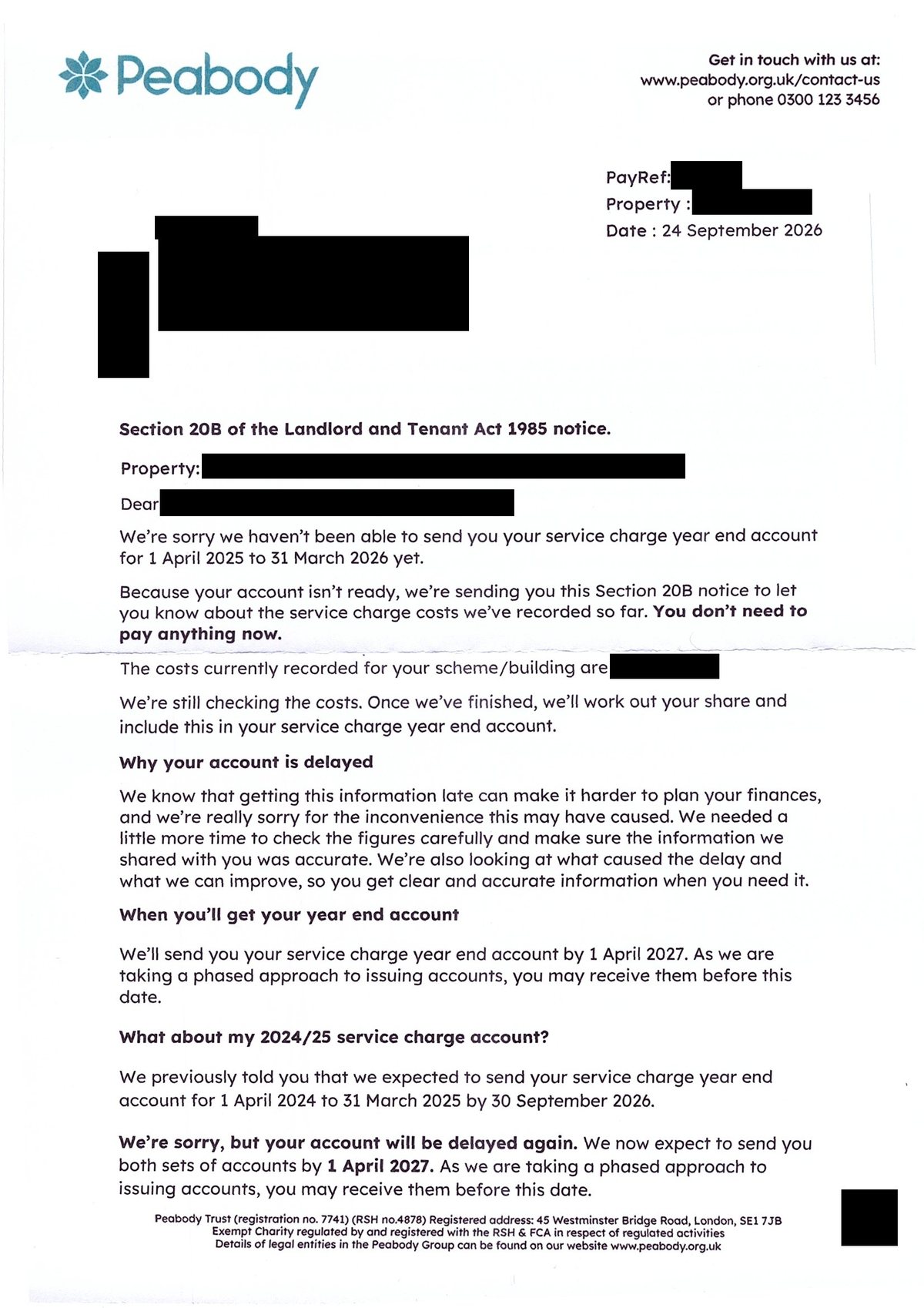
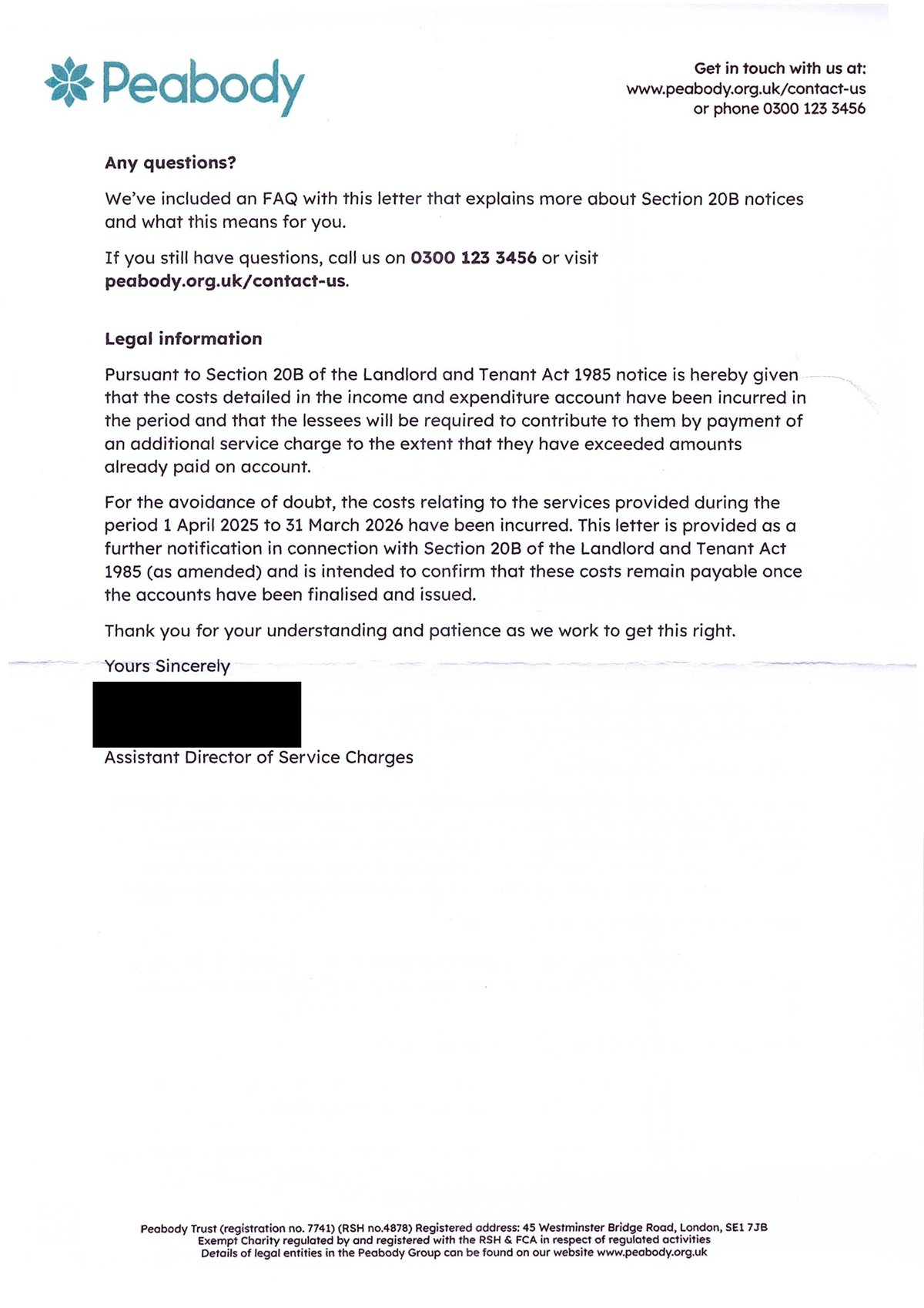
What it establishes. That Peabody wrote on 24 September 2026 to say that the service charge year end account for 1 April 2025 to 31 March 2026 was not ready and would be sent by 1 April 2027; that the account for 2024/25, which Peabody had previously said it expected to send by 30 September 2026, "will be delayed again", with both accounts now expected by 1 April 2027; and that the letter is intended as notice under section 20B that costs for 1 April 2025 to 31 March 2026 have been incurred and that the lessees will be required to contribute to them. It states a cost total for the scheme or building, which is redacted. It does not mention a leaseholder's right to ask for a summary of costs under section 21 of the Act.
Redactions. The payment reference, the property address, the recipient's name and address (including in the salutation) and the cost total for the scheme or building are removed, because together they would identify the building and the leaseholder. The signatory's name is removed and the job title left, in line with this site's practice of identifying staff by role. A small printed code at the foot of page 1 is also removed, because it may be specific to the recipient. Nothing else is removed. Peabody's contact details and registered office, which are printed on its letterhead, are left.
FAQ enclosed with the letter
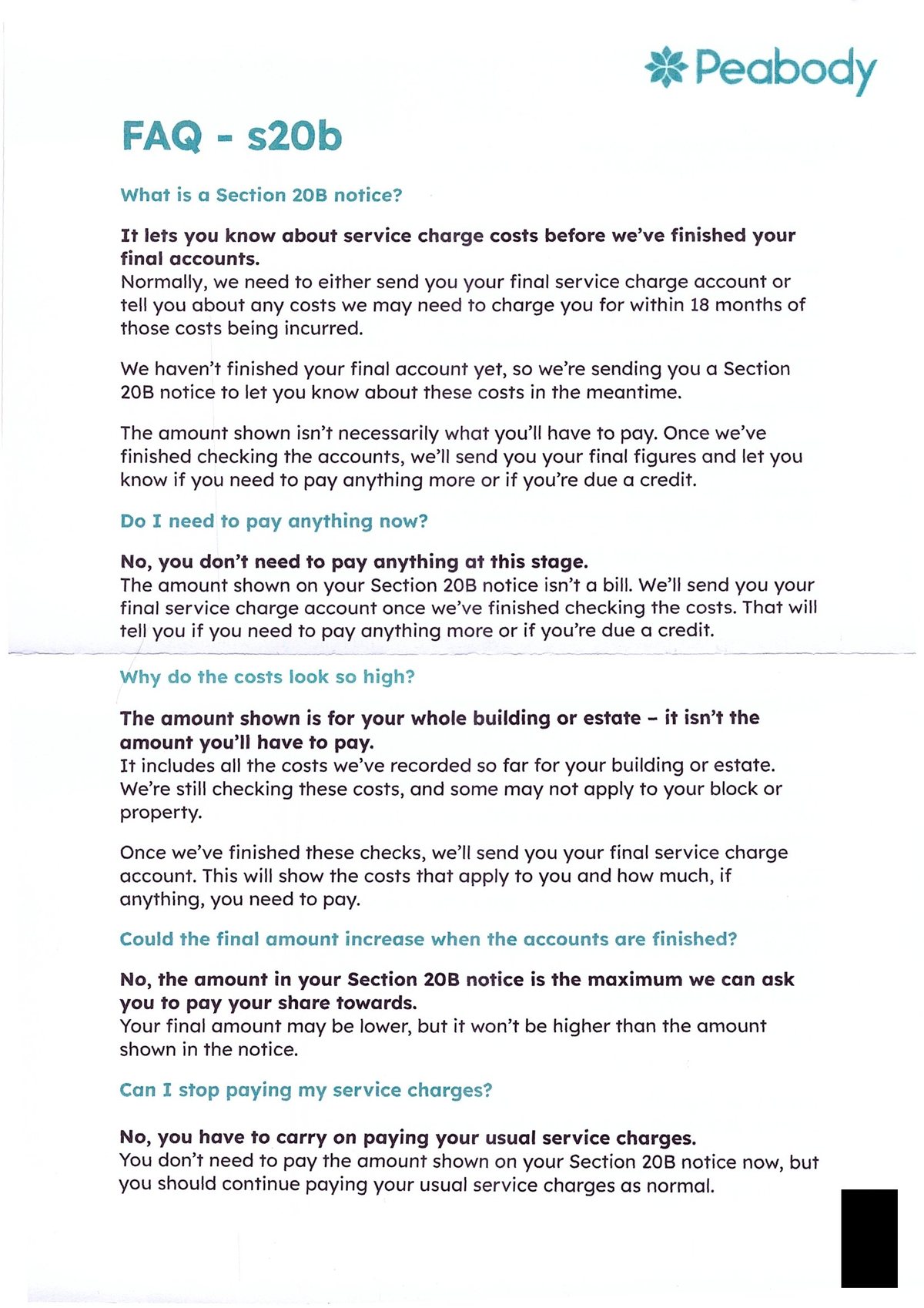
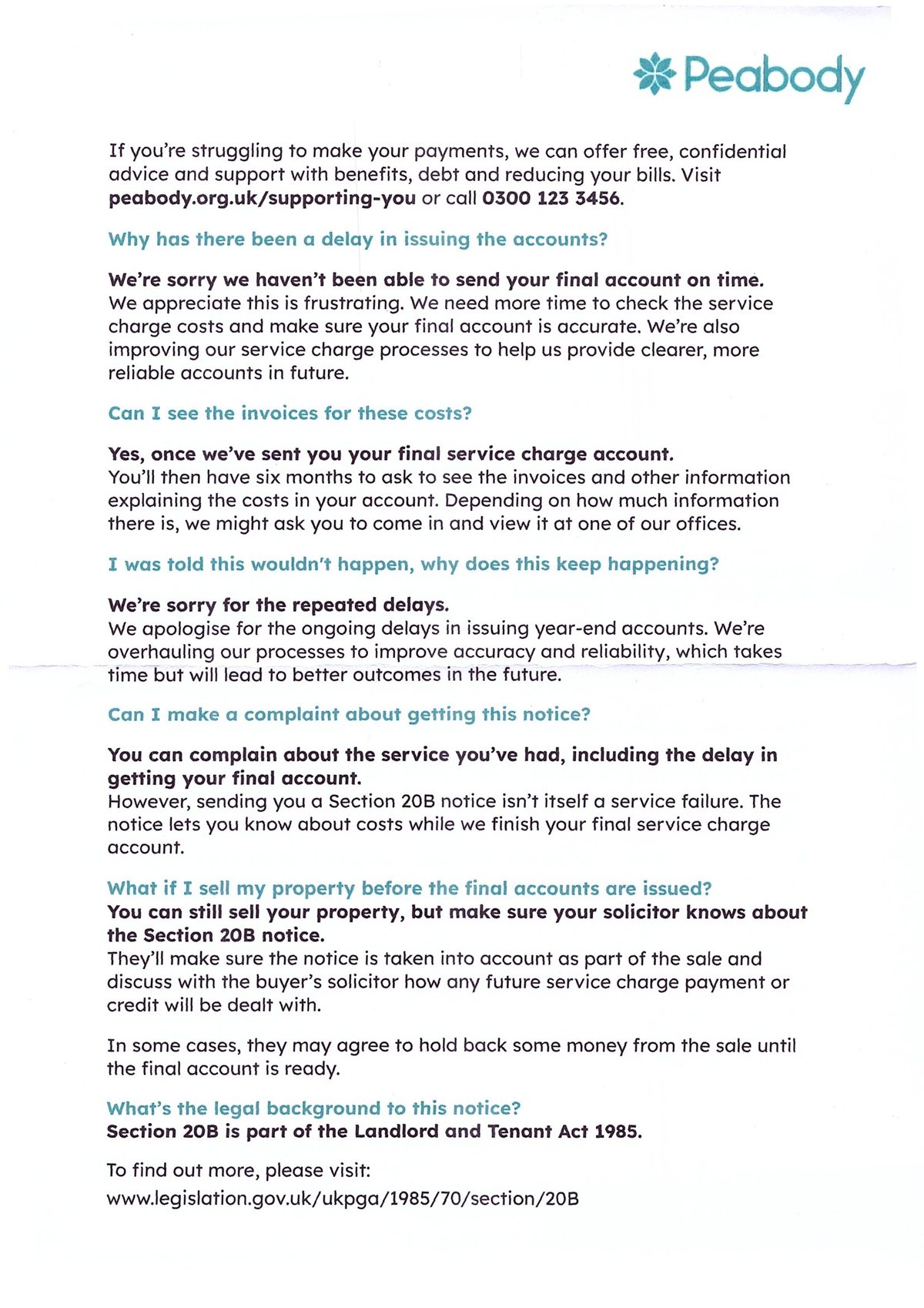
What it establishes. That Peabody's FAQ states that the amount shown is for the whole building or estate and "isn't the amount you'll have to pay"; that the amount in the notice is "the maximum we can ask you to pay your share towards"; and that residents must carry on paying their usual service charges. Asked "Can I see the invoices for these costs?", it answers "Yes, once we've sent you your final service charge account", after which residents have six months to ask to see them. It tells anyone selling to make sure their solicitor knows about the notice and says some money may be held back from the sale until the final account is ready. It does not mention section 21 or section 22 of the Act.
Redactions. A small printed code at the foot of page 1 is removed, because it may be specific to the recipient. The FAQ contains no personal information. Nothing else is removed.
Corrections
If you believe anything published here is inaccurate, incomplete or wrongly redacted, please say so. See corrections and right of reply and the corrections log.